Friday, June 4, 2010

Scutigera coleoptrata

Quite a while back when I was dealing with the natural history of arthropods you can find in your house I was asked to treat the housipede or house centipede. Finally, here it is. I don’t have a shot of this creature because I don’t see them to0 much and when I do it’s only for a second. They, like silverfish, move creepily quickly. But for those who aren’t familiar or haven’t heard the term housipede before you can check out the shots on the encyclopedia of life: http://www.eol.org/pages/1033083

House centipede is a term used to describe levels of taxonomic specificity all the way down to the species Scutigera coleoptrata and all the way up to the family Scutigeromorpha. To imagine that there’s an entire tribe of these creepy beasts running (yeah, running) around in our basements is slightly unsettling. This all started with my encounter with a spider and me singing the praises of finding wildlife indoors but the housipede is another flat, many-legged crawling critter I’d prefer stay outside.

The housidpede is indeed a member of the arthropod group of centipedes. Its first pair of legs has been modified into fangs for dealing with its prey. This is typical of centipedes. All (all) centipedes bite. It’s just a matter of how painful a bite they can deliver that classifies them as harmful to humans or not. (A quick tangent: I really like to make this clarification with jellies. All jellies sting but certain kinds, like the moon jellies that are common in Massachusetts, simply cannot sting through our skin. But the strategy of stinging with specialized mechanical cells is common to all jellies, and I believe all Cnidarians.)

Housipedes (or the specific species S. coleoptrata) are thought to be native to the Mediterranean but can now be found in many places worldwide. They, like the silverfish and thrips, thrive in humid environments which is one reason they tend to show up in our basements and (much more unfortunate for us) our bathrooms. However the housipedes are apparently predating on silverfish. So there’s a great reason to like them. Any enemy of a silverfish is a friend of mine. (Wow, I just worked two of my pet peeves into one sentence: the demonization of an animal and the description of a prey item as an “enemy.” Now I’m starting so see how emotions run so hot when nature comes indoors.)

Just Briefly...

I know you’re all probably sick of hearing about the oil spill in the Gulf of Mexico. You should be. None of us want to hear about it. We all wish it just wasn't happening. But I can’t really resist throwing in my two cents. I’m having some serious frustrations. The first is that everyone is freaking out as if this is the craziest thing that has ever happened. Don’t get me wrong: it is awful. But I will try to continue to refrain from using language like tragedy and disaster. Things like this happen every year in other parts of the world (Nigeria seems to be a popular talking point) and I strongly feel that in some way Americans should see what our out of control oil consumption is really doing to local ecosystems. And wait…what about all that CO2 we are poisoning the ecosystems with every day? How come we’re not talking about that?

Directly related to that, each time I have a conversation with a visitor at work it goes directly back to the animals. I try to link it to personal consumption, reducing ones own use of petroleum products but it has seemed (this is my personal experience) that the words don’t hit home. I’m glad they care about the kemp’s ridley sea turtles and other charismatic creatures of the Gulf. But if they aren’t able to see that their own actions are directly linked with the spill…well I’m just not sure we’re making progress.

And lastly, I was going to write about children and conservation this morning and how, for the most part, it is easy to recruit younger folks into the movement. Children have a seemingly innate love of animals and that can easily be translated into passion (though possibly blind passion) for environmentalism. With this issue (the spill) I’m not sure it works that way at all. Children are only consumers of fossil fuels indirectly through their parents. Sure we could encourage (and often do) that they talk with their parents about these issues but ultimately the grown ups are the ones making the big decisions about what car to buy and what house to buy and how to heat the home and, much more importantly, what stuff and what food to buy. I don’t have the heart to advocate that a child not buy a plastic action figure. I know. I hate plastic. I hate useless stuff. But children love action figures. Heck, I still have a hard time resisting them. For whatever bizarre reason the Star Wars, Comic Book, LOTR nerd has a hard time being confronted with plastic reproductions of his/her favorite characters. Honestly a child’s happiness is worth a little more plastic in the world. It’s a though scale to weigh.

OK, that’s my oil spill rant. You won’t be hearing any more about it from me. I get the inclination through the Marine Educator’s listserv and coworkers that some have had slightly more positive educational experiences using this ugliness as a teachable moment. Stories, please!

And I’ll try to bring you something a little more cheery by the end of the day. Even if it’s just a photo.

Sunday, May 23, 2010

Garden in the Woods

Yesterday I went to a place called "Garden in the Woods" which is in Framingham, MA. It is an educational/recreational site operated by the New England Wildflower Society. It's devoted to native plants but that really means all of the US. A lot of it is specific to New England and they have a spot where you can buy New England plants for your garden but some of the plants are from other parts of the country. It's pretty aptly named because there are a lot of woodsy areas and you'll walk along and bump into a well groomed garden area. So...a garden in the woods. When I went to the Arnold Arboretum I wrote about how it felt a lot like a museum in a lot of ways and less like being in a real natural space. Garden in the Woods has its museum-like qualities as well: there are signs on a lot of the plants with common and Latin names, a lot of the grounds are very well manicured, you have to stay on paths, etc. But like I said there are also a lot of really woodsy areas that make it feel a little more like your standard nature center. Here are some great organisms I found while walking in the woods:

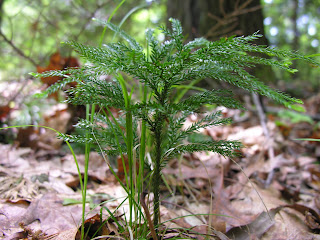
This is a club moss, not a baby conifer. I made reference to them when I wrote about bryophytes. They are primitive, simple plants related to other mosses.
A pink lady slipper orchid. Some people claim these are amazingly beautiful. I think they're a little weird looking. I was much more impressed with this next orchid:

Orchids are often bizarre and they are the most specious group of flowering plants. They often have unique relationships with single insect species pollinators.

I don't know the species of spider or plant but I think this is the coolest shot I got yesterday. It has to be viewed in full screen to be fully appreciated so check it out in the photo gallery. I also made an edited version of this shot but I really can't tell which one I like more. I'll put up both versions in a future post.

This is the flower of the pitcher plant species that lives in the Eastern US. Pitchers are carnivorous plants that have modified leaves that form a "pitcher" which traps insects.

A small frog lying on a very weird flowering plant called the golden club. None of the shots I took directly of the plant came out very well but this little frog was apparently feeling pretty photogenic.

A flame azalea, a Rhododendron species. I did not have the wits or the camera to capture it but I saw a hummingbird pollinating this plant.

New England Wildflower Society has a strong conservation message. They especially promote the use and appreciation of native plants. On the other side of the coin they try to educate about the troubles associated with invasive plant species. Then they lock those species up in invasive plant jail. Twenty years to life for disabling local ecosystems.

And who can resist an ant. Not me.

Aphids Mimicing Fungi

So as I was putting those pictures up from my yard the other day I did some quick research and found a really interesting bit of information about those red Aphids. They are pea aphids, the same species actually as those common green aphids. It appears that there are two forms of this species and the red one has managed to adopt a gene from fungi that allow the insects to synthesize carotenoids.

Carotenoids are bright red pigments and they are usually only found in plants and fungi, not animals. Animals will use carotenoids, often to display their fitness to potential mates, however. Take the cardinal. The male cardinal's color comes from his diet. He has to work hard to obtain foods rich in carotenoids to make his feathers brighter than all the other male cardinals around so when it comes time for the females to pick a mate they will choose him. It's a sign that he's healthy and strong and able to spend a lot of time foraging. So he'll be able to be a good dad and help out when the babies come. Plus he has strong genes and every mom wants their children to have strong genes.

I could only find the abstract for the paper and I'm really tempted to pay for the full article because it leaves some big mysteries. The abstract states that the red color "influences their susceptibility to natural enemies," but I'm wondering if that means birds and other animals are more likely to eat them since they contain coratenoids? Is there some advantage that the abstract does not state? What's the selective advantage? And also how the heck did those fungus genes get in there? Parasitic red fungi? I know that our genome is littered with genes from other things but those are mostly from viruses which makes sense.

So if you have any more knowledge or if you're somebody with maybe a background in genetics and have a better understanding of this stuff, please, drop me a line.

Saturday, May 22, 2010

Friday, May 21, 2010

More Backyard Biodiversity

I know: I've talked about it a lot. But it's the kid in me. I can't resist pointing out how many cool little creatures there are in one tiny plot of city yard.

These are red aphids.
And a little closer up.
See the beetles?
A little closer.
It totally lost its resolution but that gives you an idea of what it looks like.
And a spider guarding her (or possibly his?) eggs. You should really look at this one in the photo gallery, you can really see the spider's many eyes.

Salt Water Aquarium Hobby As a Window into Science Education

I was talking with a visitor at the aquarium a few days ago and he started asking me about maintenance of his salt water tank at home. He said he was having trouble with it but unfortunately this is an area of which I basically have zero knowledge. Even though I stand near salt water tanks for many hours I have not absorbed the intricacies of how to take care of them by osmosis (science pun intended).

Though I couldn't help this man and though he didn't seem particularly interested in the natural history of cuttlefish (of course to my chagrin) it did get me thinking...people who decide to try keeping salt water tanks engage in their own science education in a way a lot of people don't and perhaps this hobby could or should be promoted. He was using words like nitrates and bacteria and was very clearly aware of what was going on in the water. Even if he didn't have a firm grasp of exactly what those things were he was using a vocabulary that the average American doesn't have. He also had a different perspective on things the average person does know about: Most people seem to be firmly rooted in the idea that bacteria is always a horrible thing, lurking, waiting to make us and our children sick.

There are issues with sustainability but I am a believer in using aesthetics and appreciation to cultivate both learning and stewardship. If we as science and environmental educators encourage people to practice the hobby responsibly perhaps more people will make a first step towards developing more sound knowledge of ecosystems. Once I learn how complex it is to take care of a little 40 gallon salt water tank it makes the cognitive leaps towards a firm understanding of the complexity of real ecosystems less difficult. Once I come to appreciate the beauty of the fish or invertebrates I keep at home the more likely I am to care about the ones in the wild. Or so my theory goes. Thoughts?