Monday, March 12, 2012

The Horseshoe Crab Diaries Part Five: In Which Paul Has a Genuine Self-Directed Learning Experience

Last week I was reminded of why I do the work I do. Of course I have a lot of reasons why I do what I do: I love working with live animals, I love museum people, I love getting paid to take students to salt marshes and our other beautiful coastal New England habitats...

But the real crux of why I do what I do and not some other kind of education is that I really believe that self-directed learning experiences are the most influential on future behavior. The data back me up on this (I don't have a citation for you here, I just remember reading a lot about this in graduate school...I'd be happy to try to dig one up if anyone's interested). I had two separate experiences that reminded me how motivating (how much dopamine is involved) these experiences can be.

Last week I was teaching a class on classification (i.e. how scientists group animals and decide how they are related). We wanted to represent the eight major animal phyla but the phylum platyhelminthes (flat worms) are tough to fine. While they are a very specious and common kind of animal many of them are either parasitic or tiny or both.

So there I am, it's towards the end of the last class for the day and I'm looking at the horseshoe crab we brought. Particularly I'm looking at his legs. Horseshoe crabs have these little white boogers on their legs and when I first started my job I never really noticed them. Then I started noticing but I never thought much about them. Then I learned from an aquarist that they are alive; they're animals. So I'm standing there in class and my coworker comes over and sees me looking at them and asks "Oh...are those platyhelminthes?" I wasn't sure...but I thought, maybe they are.

Turns out they are...I immediately looked into it after work that day and found this great article about different animals that "live on limulus." There's a section a ways down about flat worms and describes the current confusion in the literature about whether these flat worms are parasitic or commensal or what. The next time you're at a salt marsh, if you pick up a limulus (carefully by the "helmet") and look at his or her legs you may notice these little white "boogers." If you poke one gently you'll see them start to move and probably notice the front of the animal poking around upwards, away from the body of the limulus. These are probably the only flat worms I've ever really observed.

These experiences (my second one involved learning something pretty specific about the way sea urchin's internal skeletons are set up...probably too technical to add to this post) reminded me of two things: I still have a ton to learn about the animals I work with and these self-directed learning experiences are highly rewarding and the most likely to direct my future knowledge and behavior. Because I went from noticing but not really knowing to noticing and curious to noticing and knowing I am a lot more likely (this claim is based on my personal experience) to remember this and be able to use this information in the future. I really don't think there's any way I can forget that those little white blobby guys are flat worms.

I think the upshot here is: if you are an educator it is your duty to try as hard as humanly possible never to stop being curious. If we are asked a question by our students or we realize that we don't understand something about the subjects we teach about it is imperative that we learn more. I knew this to be true before last week, it is something I have always believed intellectually, that the best educators are life-long learners. I just hadn't had such a rewarding learning experience like this one in a while. Thanks again, limulus!

Sunday, February 19, 2012

Story Telling

I've been thinking a lot about stories recently and how they apply to science education. My feeling is that a lot of science learning at the upper middle school and high school levels focus heavily on memorization of facts. There's always exceptions to these kind of generalizations but I also have the feeling that if we utilize the power of good story telling we may be giving our students more. A compelling story has an intrinsic way of getting into our brains and sticking there. I can't stop thinking about that research I wrote about showing how bacteria could become organelles in an amoeba in only six weeks. There are pretty meaty science facts set in that story but the fact that I first heard it as a story and then told it again as a story changes the learning that's going on. If I had read a journal article describing the outcomes of the research and posted something that just had the facts it would be a very different experience both for me and for those reading the blog. And as a science educator, remember that every piece of knowledge has a story behind it. There is a researcher or explorer that really lived or still lives who found something out about the world, often in surprising or fascinating ways. I think it's important to tell these stories rather than just explain the theories and facts that came out of them. Tell the story of Darwin's voyage on the Beagle, the story of Newton locking himself in his room and writing the Principia, or the story of Arcimedes. These were real people and their stories have a lot to teach about science and humanity.

Thursday, February 16, 2012

Natural History Reading: The Fragile Species

I am almost finished with Lewis Thomas's, The Fragile Species. Frankly, I don't recommend it. I usually flat out love Thomas's writing and if you've never read him I highly suggest The Medusa and the Snail and/or The Lives of the Cell. They are some of my favorite science writing.

In this book Thomas takes up the subject of humanity and, as a medical doctor, spends most of the book opining about the problems of public health. Since it was written a full two decades ago it is rather outdated (even though many of the public issues he writes about are still issues he addresses them from a very different perspective) and I think that has a lot to do with why it falls a bit flat.

However, nearly all the way to the end Thomas describes one of the most interesting lines of research I have ever read about. In the late 1960s some researchers at the University of Buffalo, including one Dr. Jeon, were doing some work on amoebas. They had found a way to transplant the nucleus of one amoeba strain into another. Amoebas are unicellular eukaryotes, the very simplest creatures in the lineage that eventually reached us. This transplanting technique offered up a good deal of insight into genetics.

Tangentially, it would seem, some of Jeon's cultures became infected with bacteria. Rather than just destroy the cultures and start fresh, Jeon fought to keep his precious experimental organisms alive and healthy. He succeeded in getting them back to apparent health; the amoebas returned to reproducing at their normal rate, indicating they were healthy. However each still contained a load of about 50,000 bacteria.

Jeon began some experiments to get rid of the bacteria entirely. He found whenever he was able to destroy the bacteria, such as by exposing them to a heat they could not tolerate but the amoebas could, the amoebas promptly died. Quickly Jeon discovered that they amoebas and the bacteria had become symbiotic. Perhaps more accurately, the bacteria had become organelles; they were now vital to the amoebae.

By thinking long enough about it I felt I had resolved how something like our relationship with mitochondria could have evolved but this experiment shows that it can happen in a remarkably short amount of time. By continuing this line of work the researchers found that it could happen in as little as six weeks. Six weeks! To potentially develop an entirely new kind of living thing. Potentially an entirely new kingdom could develop out of this kind of event. This is, in fact, probably how eukaryotes first arose from prokaryotic ancestors. One bacteria infected another bacteria and then they simply became organelles.

Weird but true science. I feel like a description of this experiment should find itself somewhere into any introductory biology course whether at the high school or college level. This is just remarkably cool stuff.

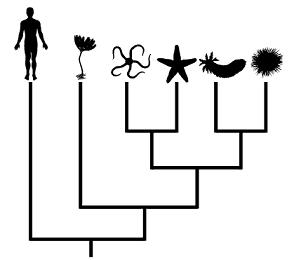
Phylogeny


This image made me laugh out loud. It accuarately represents the phylogeny but the fact that the chosen representative for the echinoderms' sister group, the chordates, is homo sapiens, is pretty silly. We are very derived chordates. If you laughed out loud on first site, you too might be a huge nerd.


Wednesday, February 15, 2012

Misinformation

This article, published on the National Geographic website, came across my radar today:


I hesitated to even post it because this, frankly, is just bad reporting. I'm ashamed at the National Geographic for allowing it on their website. Here's why it's not journalism:

The title of the article claims "Shark-Attack Deaths" are "Highest in 19 Years." What the article fails to mention, and what the "journalist" who wrote the article probably didn't even bother to research, is that 2011 shark attack deaths went from the average of 5-7 to 12.

So there's one way to say that. You could say it doubled. O my! The sharks are out to get us! But then, if you take a deep breathe and remember how to do actual statistics you might remember that when you compare the numbers 7 and 12 to the billions of times human beings go swimming every year this figure becomes literally (and I am really using the word literally) meaningless. There is no statistical significance. Period. It's like comparing the mass of two objects and being short a couple of protons.

So I'm not just hyperbolizing this time: this article is actually not saying anything. So if anyone asks you about the rise in shark attack deaths...now you know...they're just not on the rise.

Saturday, February 11, 2012

Blog

Natural selection has acted on the mycelial network and it has speciated!

To view the mycelial network's sister clade go to http://oneswoop.blogspot.com/.

The blog is called "One Fell Swoop" but the url onefellswoop.blogspot.com was taken by a blog with only one post that has not been updated since 2002. The one post is moronically self indulgent, too, something about getting a haircut. I'm pretty sure it was written by a teenager. Which is not to say teenager's shouldn't write but...I mean just go look at it for yourself.

In any event I ended up with the url oneswoop.blogspot.com. Which is annoying. But there it is. I have no idea who should read this blog. I have no idea what the purpose is. I'm pretty sure it's a blog about "hey, isn't this weird/cool/interesting/crazy/etc."

(Disclaimer: this is not actually how speciation or natural selection work.)

Friday, February 10, 2012

Reblog: Radiolab's Killer Empathy

I seem to have completely lost my ability to write. In the meantime listen to the folks at Radiolab talk about someone who works with giant crickets.