Friday, April 30, 2010
Natural History at the PCM
Just posted on the blog of the Providence Children's Museum is an interview with Chris Sancomb, the designer/fabricator, about their upcoming exhibit "Underland." I'm very excited about Underland for a lot of reasons, not the least of which is that I was able to help, minimally but I hope influentially, at the very beginning of researching content for the exhibit during my AmeriCorps year at the PCM. I also had a chance to work a bit with Chris during that year and he is one of the smartest, most creative people I've met in the museum world. His work is fairly unique as many museums contract their actual fabrication out to others. I found his comments on the visual style of the exhibit especially interesting. Take a look: http://providencechildrensmuseum.blogspot.com/2010/04/interview-with-chris-sancomb.html

The Teaching of Evolution
The teaching of evolution is very near and dear to my heart and I was excited to find out a coworker of mine is doing a project about measuring people’s familiarity and comfort level talking about evolution by means of natural selection. I may have mentioned this but improving evolution literacy in the
Yesterday I made a comment about my primary mode of instruction being to talk explicitly about evolution unless directly told not to in front of some other coworkers. I had been teaching at a Catholic school that day and the reactions were generally of surprise. “Really? You aren’t afraid to talk about evolution?” No. Absolutely not. I am just as sure about evolution being a part of science as I am the water cycle or force being a product of mass and acceleration. The really weird thing is that we are constantly talking about adaptations as if they are this completely separate aspect of animal science. They are not. Adaptations are a product of evolution by means of natural selection. If you tell students that an animal has an adaptation for living in its environment you are telling students that the animal has evolved. Plain and simple.
We’re also constantly talking about animal relationships. Seastars are related to urchins. Octopuses are related to squid. Just like adaptations, phylogeny is a direct admission to our belief in evolution. If animals did not change they would not be related. So why then are we afraid to use the “e” word or talk about my hero Charles Darwin?
More to the point, I firmly believe that we will get nowhere if all we’re doing is taking baby steps towards teaching evolution. We don’t play this awful game with cosmology or geology or really any other branch of science. It is only evolution that remains a political battle.
So I’ve been wondering for a while: how do you talk about evolution? Do you hold back and reserve your comments and teaching to things related like adaptations and relationships? Or do you really insist on the truth of evolution by being unabashedly afraid to talk about the topic with students and the public? Do you believe as I do that it is our responsibility as science educators to encourage a belief in evolution or do you see it as an unimportant and/or evolving (no pun intended) aspect of the publics view of science? Is it inevitable that an acceptance of evolution by means of natural selection eventually become common? And how long will that take if we are not making active strides towards its acceptance?
As always any thoughts, comments, personal attacks on my character are welcome.
Friday, April 23, 2010
Origin of Species Graphic Adaptation
I really don't like the word "graphic" when applied to comic books...but this is totally off topic.
In any event: I must have known about this and then forgot but late last year the comic book (graphic) adaptation of Darwin's Origin of Species was released. Here's a little blurb about it from the Panda's Thumb:
Hopefully I'll get back to writing real posts soon. I was correct in predicting a busy month. But the good weather means I'll be out in the woods a lot, hopefully.
Thursday, April 22, 2010
Earth Day Today
Here it is: Earth Day. I've decided that I'm going to observe the day by going without electricity for a full day on Sunday. I thought trying to do this on a work day would be silly because I really don't use that much electricity at work and any that I do use is pretty much necessary for the job. I've already thought a lot about how this might go and I think the most annoying things are going to be not being able to listen to music and not being able to use my camera. Lousy digital technology. I knew there was a reason I should have held onto that film SLR. Depending on how this goes I'm hoping to turn it into a No/Low-Impact sabbath...maybe once a month? We'll see how it goes...
In other Earth Day news there's an outdoor concert going on this afternoon on the Rose Kennedy Greenway featuring World's Greatest Band They Might Be Giants. It's from 12-3 so barring any thunderstorms you should check that out if you live around the city. Hopefully my lunch hour will be around this time so if they're not being attacked by lightning I may get to see TMBG.
What are your Earth Day plans? Wishes? Gripes? Hysterical Doomsayings?
Sunday, April 18, 2010
More Cepaea nemoralis
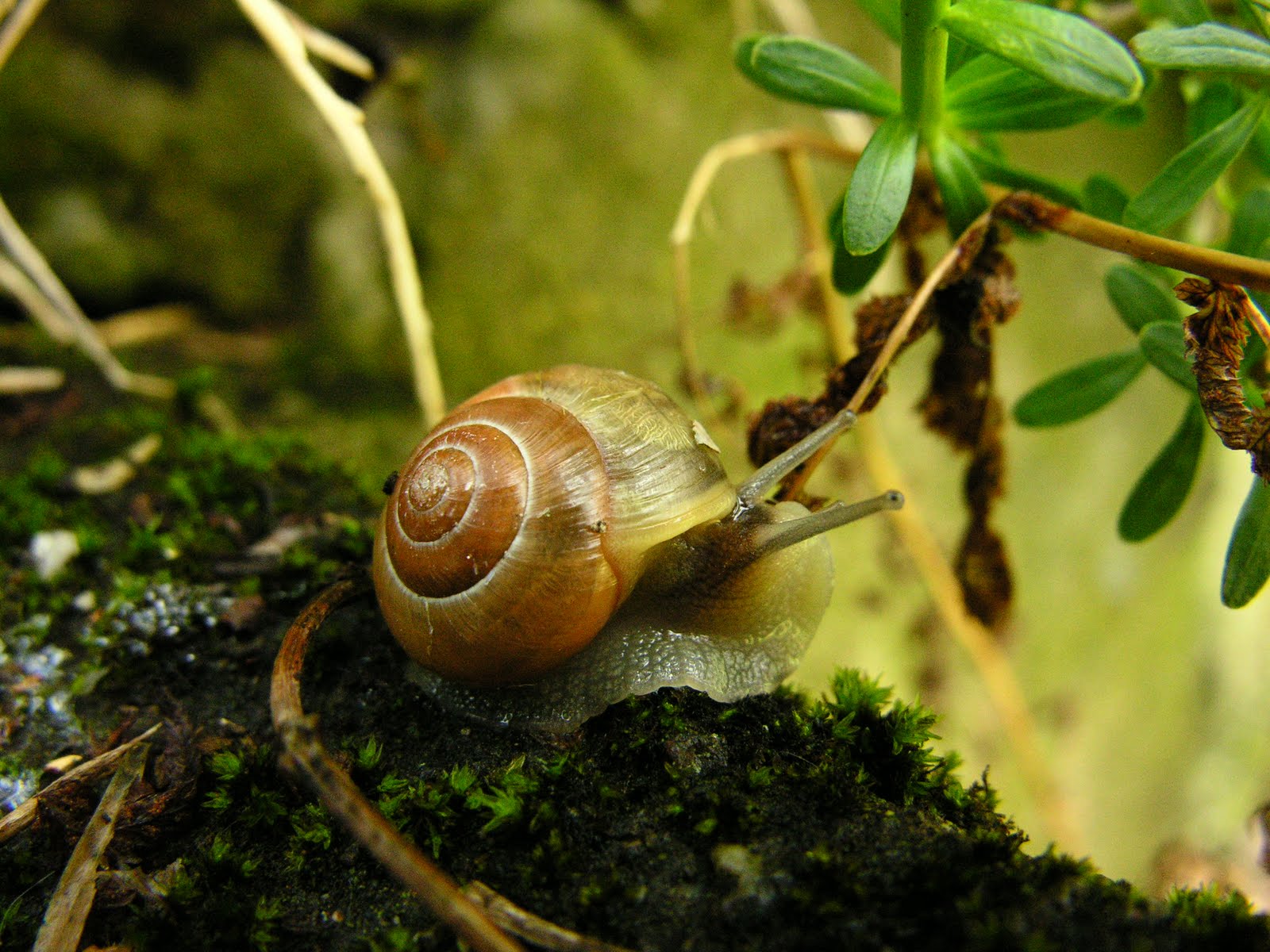


I wasn't entirely happy with the shot I got of the grove snail so I went back out and found another one. I like these especially because they make the yard look like a jungle.
Cepaea nemoralis
 Most of my wildlife photos are of plants and fungi for one simple reason: they don't move. This makes them much easier to shoot than most animals. Luckily the grove snail or brown-lipped snail is slow. That gave me time to run inside, grab my camera and return in time to shoot one this morning.
 These snails are found from spring to late summer in our yard. Apparently this species is native to Europe and was intentionally released by a British malacologist (one who studies molluscs). I suppose he was a tad homesick and wanted to see the garden snails from home thrive in the States. There isn't a whole lot of information out there on C. nemoralis but one interesting fact that extends to many gastropods (the group containing snails and slugs) is that they are hermaphrodites and when two individuals mate they are both fertilized.
A Walk in the Woods
The thing I miss the most (and probably the only thing) about living in the suburbs is that I could walk a few steps from my door and be in the woods. It was relatively easy for me to get so deep in the woods that I couldn’t see any of the surrounding houses. This is much more difficult (or at least time consuming) in the city and generally involves driving. Luckily I do live within walking distance of the Arnold Arboretum. I go to the arboretum a lot but last weekend we took our first walking tour and got to learn a little about some of the plants.
This walk in the “woods” had me thinking about two things related to natural history education. First is the notion that this isn’t really natural at all. Our guide even said, fairly close to the start, that the arboretum is more like a museum. I do love museums but you can’t get the same experience of exploring in a real ecosystem from strolling along wide boulevards and seeing intentionally planted plots that are mostly carefully manicured with non-native plants. After having visited the arboretum so many times, getting the tour felt almost like viewing taxidermied animals under glass. There was certainly something educational going on but my brain was thirsty for something different. Something more wild.
The second thing related to natural history education was reinforced by a talk I went to Monday night by a science writer. This is the role of the non-expert in science education. Now, I am certainly not an expert in science. I have a master’s degree but it is in education so I certainly fall into this category. Also, I would hazard that most science education below the university level is being done by non-experts. But I was struck by the amount of “I don’t knows” given by the tour guide and dubious or downright incorrect information given by the speaker on Monday. There’s nothing wrong with saying I don’t know. It is much preferable to giving out incorrect information. But I had come to the tour to learn about plants and there were very few plants I really feel like I learned anything about. And I cringed several times at Monday’s talk when I heard something that I knew would be taken the wrong way by the average listener.
Both of these experiences got me thinking: what is the role of the non-expert? What responsibility do any and all of us who teach science to young people have to make certain we have our facts straight and that we keep current with new research that may alter those facts? What methods and sources do we use to do this?
For myself I believe in nearly constant learning. I try to read science news on at least a weekly basis if not every day. When I don’t know the answer to a question someone asks me I almost always look it up. But then I have the time and curiosity for this. So I’ll leave you with the photos of arboretum plants.

Umbrella Pine

lindera augustifolia

Linden flower

Lavalle Cork Tree

Katsura Tree

Assorted Cherry Trees
Subscribe to:
Posts (Atom)
