Monday, April 20, 2020

Exploring Nature at Home

We're only a few days away from the 2020 City Nature Challenge and obviously this year is going to be a little bit different.  You can visit their website, and specifically this page, to learn about what is changing and what isn't.

Unsurprisingly, while we are still going to try to get out and collect as many observations as possible, we will be doing this while social distancing.  For many of us this will mean observing the natural world in patches of green space in our neighborhood, our back yard or even just from our windows.  The other big change is that this year will not be a competition and some of the organizers are using the phrase "City Nature Celebration."  They also put together this guide on exploring nature at home.

I also recently wrote about exploring the natural world at home, even if it means you can't or don't feel comfortable going out into your neighborhood and wanted to share that here.


Even though we may be spending most of our time at home there are still ways to explore nature with your family!  Whether you are able to get outside to a park, green space, yard or you can only make observations through windows or from a porch there are lots of options for looking closely.   Here you will find resources, tips and ideas for you and the young people you care for to engage with the natural world! 

The Big Picture

No matter where you are exploring there are a few basic tips and tricks for helping young people explore the natural world you can always rely on:


  •        Look closely and ask questions: what colors do you see?  What do you think this animal is doing?  How many legs does it have?  How many trees can you see?  What do you think we might find next?  What is the weather today? 


  •           Record what you find: use whatever paper and writing tools you have available at home to keep track of what you find and notice.  If you have the ability to hang pieces of paper or keep your observations in the same notebook over time that can provide an opportunity to look back and talk about what patterns you see, what is always the same and what changes.  But if not, just the act of drawing or writing down your observations is a great way of focusing attention and solidifying observations in memory. 

Window Observations

This is a simple, flexible activity you can use to connect with the natural world even if you don’t have access to green space at or near your home.  As written, you make observations through a window but you can also take a short walk through your neighborhood, go to a yard or park, if you are able, to make observations.  Try both and see what differences you notice between the window and your walks!

What you need: a window (optional: chart paper or any smaller kind of paper, pen/pencil/marker/etc, book or online field guides [see web links below], binoculars).

What you do: Choose a window, or several windows, where you can see a variety of plants, animals and weather.  This activity can be done with a single observation or over the course of days, weeks, months or even years.  No need to plan ahead if you don’t want to commit, though.  If you are using paper to record what you see, get out your paper and something to write. 

 Here are some things to look for and guiding questions as you observe:
·         
        Start off open ended: what natural things do you see?  What colors do you see?  Trees, animals,       weather, sky, clouds, rocks?  Start to get acquainted with your window or the section of your   neighborhood you have chosen to watch. 

·         What is the weather like?  Recording weather across a week, a month, or a longer period of time and   then going back and looking for patterns or trends (does the temperature go up each day, down each   day, up and down?  How many days were sunny vs. rainy vs cloudy?)  is a great but very simple   way  to engage with the natural world. 

·        What animals do you see?  Don’t worry about having to identify species at first.  Squirrels?  Birds?   Can you describe them?  What colors are they?  What do you see them doing?  Are they big,   medium or small? 

·         As you get to know the animals outside your window or in your neighborhood you can start to use   field guides to identify what species they are. 

·        What trees and other plants do you see?  Like animals, don’t feel you have to know the specific   species at first.  Are they tall or short?  Do their branches go up or out?  Do they have leaves or   needles? 

·        Don’t forget rocks!  Rocks will be a little trickier to identify from afar but go back to those open ended observations: what sizes do you see?  What colors?  Try to challenge your young people to get more specific than “gray” or “brown.”  Light or dark?  Greenish gray?  Try to get them looking and thinking as closely as possible. 

·        If you’re able to be up after the sun sets (and it is safe for you to do so), try making some observations after dark.  What are some things you notice that are different?  What’s the same? 

·        If you choose to continue making observations over many days, choose a time (maybe each week?) to go back and look and what has changed over time.  Are you noticing different animals across the weeks?  Do you notice different behaviors?  When do plants grow, lose their leaves, grow their leaves?  What patterns or trends have you noticed in the weather? 

Identification Guides for Window Observations
Tree Identification by Bark: http://www.trees-id.com/bark-1.htm
(For Plants) Go Botany Simple Key: https://gobotany.nativeplanttrust.org/simple/

Exploring for Nature Inside

What you need: you can explore inside or outside your house for insects and other invertebrates without using any special materials.  If you have a small jar or Tupperware container at home that can be helpful to place small creatures for viewing but it’s just as easy to observe them where you find them!

Just as with window observations, you can add a record, note-taking or drawing component to help your young people look closely, find patterns and ask questions about longer-term animal behavior. 
While not everyone agrees that they are the most welcome inhabitants, most of our homes are also inhabited by a range of insects, spiders and centipedes.  Hunting for these smaller animals in your basement, attic, bathroom or other out-of-the-way areas is another great way to engage with nature without leaving home!  While these creatures may not be the most popular, it is perfectly safe to explore for them.  There is only one potentially dangerous species of spider in Massachusetts, the very distinctive black widow.  While you are unlikely to encounter it (these spiders are much more common in the South and West United States) you can find information about identification and their behavior here. 

Identification and Resources for Bugs in Your Home

Exploring for Insects and Other Invertebrates in Your Yard

What you need: As with exploring inside, this can be a very engaging activity without any materials.  If you happen to have a small shovel for digging into the soil that can help find certain creatures, especially earthworms and insects that winter in the soil.  Again, a small jar can help keep creatures in place to view them but is not necessary for observing outside. 
If you are able to explore a yard, park or other green space in your neighborhood you are likely to be able to find not only birds, squirrels and other vertebrates [animals like birds, mammals and reptiles that have  a backbone], but also a host of smaller invertebrates [animals without a backbone like insects, spiders and snails] hiding on plants, under rocks and logs and in the soil.  Here are some resources for how to best find these smaller creatures all around us. 

Wednesday, December 12, 2018

Scientific Consensus and Uncertainty

There is a line of thinking, you may have encountered it, that says something to the effect of "there is no such thing as consensus in science."  The argument goes that in science we never prove, only disprove and we are always discovering, learning, tweaking and we should always be holding what we believe to be true, especially the theories and laws most dear to us, with skepticism.  Therefore, we should not or cannot ever have consensus.  There should always be room for debate in science and consensus is a tool of the powers of authority to stop those that would challenge this authority. 

The real difficulty with this line of argument is that it takes something that is true and good about science (that we only disprove, that we constantly amend our theories when new observations or information is collected, that we should remain skeptical) and takes its logical end creating such epistemological relativism that would dictate we can never know anything or ever do anything with that knowledge.  Which is demonstrably not the case.  We do know things and we do things with this knowledge. 

Let's think about how this applies to engineering.  We've studied steel.  Steel is great; it's fairly plentiful (rather it's components are), it's very strong, it's relatively easy if somewhat energy intensive to make stuff with.  So we have an idea: let's build stuff with it!  Let's use it to build some buildings!  Modest at first but eventually, maybe we can build some really tall buildings!  Now if your position is really that we cannot build scientific consensus you'll say: "No, no!  We need to continue to learn about steel!  Perhaps there is some hidden property that we're unaware of that would make it unsafe to build with!  What if there is an as-yet-undiscovered reaction that occurs when it reaches a certain elevation that makes it impossible to build tall buildings with?"  But we do build with steel.  We've reached a level of confidence that allows us to say "we know enough about this material, we understand its properties, let's move on and do some engineering with it." 

While it is true that nothing in science is ever proven in the strictest sense, confidence is a technical term for how statistically likely it is for future experiments or observations to hold with past experiments and observations.  So while we might not have proven that steel is a good building material, the statistics are very much in our favor. 

We also do have what we call scientific facts.  A fact is a piece of knowledge that, again, has been tested over and over and over to such an extent that statistically we have very strong confidence that it is for practical purposes "true."  One of the go to examples of this would be if you hold an object in your hand (that has greater density than air) and let go of it, it will fall.  Steel's high strength is a fact.  Atoms consist of protons, neutrons and electrons: fact.  Now could we discover new aspects of the natural world that counter these observations?  We could.  It's just very, very unlikely. 

"Ah!" Says the anti-consensus line of thinking.  "But in science there is no "truth."  We've been wrong before and we could be wrong now!"  Yes, many many scientific facts, laws and theories that were consensus for very long periods of time have not held up to the scrutiny of the scientific method and new evidence.  It's quite true.  We once believed in something called "the aether," a substance through which light waves could propagate.  It doesn't exist; we now know that light and other electromagnetic waves are self-propagating.  We once believed there was a substance called "phlogiston" within all combustible materials.  We had lots of evidence based on observation and experiment that such a thing existed.  It turns out we were wrong. 

Scientists and consensus can get locked into what is "accepted" and fail to pick up on evidence that would lead us to new theories, facts and laws that better explain our observations.  This is a very real aspect of the scientific method.  But saying that we cannot ever have enough confidence in our observations to do anything with them is throwing the baby out with the bath water.  And, again, demonstrably false.  Engineering is nothing but taking scientific facts, measurements, theories, etc and applying them.  We reach consensus whenever we build new infrastructure and technology.  Whenever we develop medicine (and yes, sometimes we make mistakes) we are reaching consensus.  When I know that jumping from a great height is a bad idea because gravity will accelerate me quickly to the ground and severely injure or kill me, I'm working with scientific consensus.   

You may see this argument applied to climate science and climate change.  That because science never proves anything, saying that there is a consensus is antithetical to the scientific method and merely serves to silence dissenters.  It prevents us from making new discoveries.  But here's what we know: it is a scientific fact (in the technical sense) that carbon dioxide and other gases trap heat in our atmosphere.  It is a historical and scientific fact that humans have added a bunch of rampant carbon dioxide to Earth's atmosphere.  Therefore, we can infer (and have measured) a rise in average atmospheric and sea surface temperatures.  We have observed ice that has existed since humans have melting.  We have a very, very high level of confidence in these things.  And we have a very high level of confidence that Earth's atmosphere will continue to warm and that this will have other effects on our climate. 

Do we know exactly what will happen with the climate?  No, of course not.  We have some decent models but there are a host of variables we can't predict very well (mainly the social variables, i.e. what are humans and governments going to do as we move into the coming decades).  Humans are notoriously difficult to predict.  But just because we don't have a perfect climate model with extremely high confidence doesn't mean we don't still have some basic facts that allow us to act in a logical, reasonable way. 

Good scientists are always skeptical, always open-minded.  Good scientists do their best to truly think critically and examine if their observations are in conflict with what they believe.  But good science also allows us to create, to heal, to feed, to protect.  Good science allows us to act and not only study. 

Sources:

Kuhn, Thomas.  The Structure of Scientific Revolutions.  Chicago and London: The University of Chicago Press, 1962.

https://www.visionlearning.com/en/library/Process-of-Science/49/Uncertainty-Error-and-Confidence/157

https://eic.rsc.org/feature/the-logic-of-phlogiston/2000126.article

https://ncse.com/library-resource/definitions-fact-theory-law-scientific-work

Saturday, August 11, 2018

The Speed of Light and Time Dilation

So light is fast.  But its speed isn’t necessarily special.  It just travels at the highest speed the universe allows.  Photons (the particles of light) have no mass so, like all things without mass, they have nothing to slow them down.  So off they go as fast as they can!  Why is there a universal speed limit?  The answer to this is, like other questions about the fundamental nature of the universe and laws of physics, we simply could not exist in a universe with infinite speeds.  There are two things that would go wrong for us:  1. It would take infinite energy to give something mass and so things with mass (like us) couldn’t exist.  2. Time (or to be more precise, really, space-time) wouldn’t exist.  Light travels at the fastest speed a signal can be sent in our universe.  Because we have a finite signal speed it means that events have distance and time between them.  This is quite odd to say, but an infinite speed of light or infinite signal speed would mean that there are not distances and times between events.  How would a particle with infinite speed actually behave?  A signal (or particle) with infinite speed would exist everywhere in the universe at once.  These particles would never take any amount of time to go anywhere and would never need to travel anywhere because they all would already be everywhere forever.  So while such a universe could exist we wouldn’t be around to observe it.  Nothing, really, would be around. 

Because the speed of light is always at the fastest possible speed the universe allows this has a weird byproduct: light’s speed is not relative to the observer.  It is always the same.  Here’s a little more detail about what that means and following, a little about why that’s weird.  Imagine someone on a train car going 100 km/h, you’re standing still watching the train car go by.  Now imagine they throw a ball at 50 km/h.  From their perspective the ball is going 50 km/h.  But from your perspective the train and the ball add their speeds together and the ball is going 150 km/h.  For most moving objects in the universe you have to measure their speed from a particular frame of reference.  That is, are we measuring the ball’s speed from your frame or from the person who is throwing the ball?  We will get different answers depending on which frame we decide to measure from.  But because light always goes at the maximum speed allowed by the universe, this does not happen for light.  Let’s go back to the train car only this time the person on board has a flashlight.  They’re traveling along again at 100 km/h.  They turn on the flashlight.  From their perspective the photons exiting the flashlight are going c (the speed of light, about 300,000 km/s). From your perspective the photons are traveling?  Also c, exactly the same speed.  Not c + 100 km/h.  

Here’s the weird thing…at least weird from our day to day experience:  the fact that light travels at the universal speed limit and its speed doesn’t change based on any frames of reference leads to time being experienced differently when travelling at different speeds.  Let’s go back to the train car.  This time, imagine there are mirrors inside the car and a beam of light bouncing between them.  The light beam is bouncing straight back and forth and takes some very small amount of time to make one bounce.  This is what it might look like, the back bars being the mirrors and the blue bar being the light beam:

Now, let’s set the train car moving.  Now the light beam must bounce at a diagonal and travel a slightly longer distance in order to “catch up” with the moving car.  Here’s what this looks like, again, the black bars are the mirrors, spaced out to show the movement of the train car:

Just like with the ball thrower, with most objects the train will just impart its speed on the object and we will see it go faster to keep up with the moving train across the slightly longer diagonals.  But here’s where things get weird.  Remember that light cannot go any faster and that it always goes at the speed c regardless of frame of reference (so its speed is the same if you are observing from outside the train or on the car).  If the speed can’t increase it seems we may be stuck with a problem: the light has to travel a longer distance in the same amount of time but it simply can’t because the speed of light is conserved no matter what.  Here’s the punchline: instead of adjusting the speed of light, the universe adjusts how much time passes for each frame of reference.  From outside the train time on the train actually slows down so the light has enough time to get back and forth from mirror to mirror.  From inside the train time appears to move at a normal rate.  But from outside, time is moving slower.

This is the phenomenon known as time dilation.  We don’t really start to see significant effects until we get pretty close to the speed of light but this happens every time you move with respect to someone/something else.  Every time you get in a car, train, plane, skateboard, bicycle, heck even walking, time slows down for you just a little bit.  So be wise, friends.  Choose something productive to do with all your extra nanoseconds. 

Some references:


Cox, Brian and Jeff Forshaw.  Why Does E=MC2?  Boston: Da Capo Press, 2009.  


Saturday, March 17, 2018

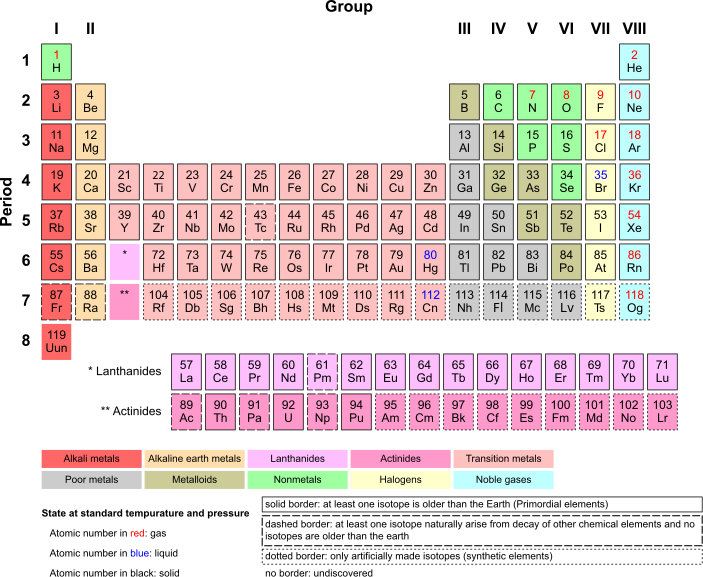
What is a Chemical Element?


Periodic Table Armtuk3.svg
Source: Wikimedia Commons

The periodic table of the elements organizes all the chemical elements.  Elements are, in most ways, the fundamental building blocks of the kind of matter that we are most familiar with.  You can go smaller than an element and find protons, neutrons, electrons and quarks (and possibly go smaller/more fundamental and find strings).  You can go bigger as well and find molecules built of several elements.  Most of the matter we interact with is made up of molecules containing multiple elements.  But in order to have water or wood or a zebra you need atoms of various chemical elements. 

While most of the stuff around us on Earth is made of compounds, often quite complex compounds when it comes to what makes up living things, we do have some experience with stuff made from single elements.  This is known as a "natural state."  Graphite, the stuff we use to make pencils write, is pure carbon arranged in layers that can easily slip off the tip of the pencil and onto the paper.  Diamond is actually one giant carbon molecule.  Oxygen, while we have a less tangible relationship with it, is perhaps the most important substance to us for, y'know, not dying. 

We also have experience with some metals as single element substances.  Aluminum is used to make foil and cans, silver has been used to make well...silverware and other household items, gold is used in jewelry and wires.  While these metals are often found naturally occurring in a larger compounds we have figured out how to use chemistry to remove the atoms of just the metal.  Natural state metals are extremely useful because they tend to be extremely malleable (you can mash them into a shape, like clay...though, this may require some pretty extreme heat) and conductive (these properties are why gold is so useful for wires). 

Though it may be a bit indirect, we also may have some experience with neon in the form of neon lights or signs.  We use several other gases that are chemically similar to neon to make these lights.  When excited with electricity, these gases will produce different colors.

But these are all experiences of substances at a gross macro level.  We can talk about malleability of metals or how neon glows when excited by electricity.  The factor that makes an atom a given element, though, is the number of protons.  You can change the number of neutrons (and get an isotope) or the number of electrons (and get an ion) but if you change the number of protons in an atom, you change the element.  Thinking about how that translates to the macro level can seem...a little strange. 

Take carbon again as an example.  Right next to carbon on the periodic table is nitrogen which, among other things, makes up most of Earth's atmosphere.  It seems, for lack of a better word, weird, that adding a proton to the nucleus of an atom would make carbon into a gas.  But that exact thing happens all the time!  Well, in geologic terms.  All elements have what is called a "half-life."  This is the time it takes for half of a given sample to undergo a transformation into another element.  Energy is required to hold even many smaller atoms together and so they do not last forever.  In the case of carbon, carbon 14 (which has 6 protons and 8 neutrons) "decays" over time and becomes nitrogen 14 (7 protons and 7 neutrons). 

What we more commonly think of as "radioactive" substances are substances that do this much, much more quickly.  Larger atoms like thorium, plutonium and uranium also tend to decay in a way that involves particles being shot out of their nucleus.  It is these particles, along with the much faster rate (carbon 14 decays in about 6,000 years, the most stable isotope of thorium in just around 18 days) that makes these isotopes dangerous. But it also means they actually turn into other elements on the scale of human lives.

The alchemists' quest to turn lead into gold may not really have succeeded, but humans have found ways using particle accelerators to ram protons into atoms so fast that they stick, changing one element into another.  While experimenters have succeeded in turning other elements, like bismuth, into gold, this is only at the level of about a thousand atoms in a given trial.  This is about a billionth of a billionth of a gram of gold.  So while it may not be what the alchemists were looking for, it does experimentally show that what we think of at the macro level as a fairly stable, concrete thing, is changeable and just comes down to the number of protons found in the nucleus. 

So what is a chemical element?  Like many things in the natural world, it depends on what scale you're asking.  At the macro level gold is a shiny metal substance that's really good for making things like rings and wires and such.  But at the atomic level it's just the number of protons in the nucleus.  If you add a proton to gold it becomes mercury and, at least at room temperature, it melts. 

Sources:

http://www.preservearticles.com/201012302013/carbon-14-deca.html

https://cosmosmagazine.com/chemistry/how-noble-gases-give-us-neon-lights

http://www.bbc.co.uk/schools/gcsebitesize/science/aqa_pre_2011/rocks/metalsrev1.shtml

http://www.bbc.co.uk/schools/gcsebitesize/science/add_gateway_pre_2011/chemical/nanochemistryrev1.shtml

https://www.livescience.com/23232-smallest-ingredients-universe-physics.html

https://www.youtube.com/watch?v=7g-WOMXe6Mo

https://www.scientificamerican.com/article/fact-or-fiction-lead-can-be-turned-into-gold/

Saturday, November 4, 2017

I Don't Think This is a "Post-Truth World"

I keep hearing about the challenges of science communication in a “post truth world” and I think that framing our challenges in this way plays into a false narrative.  I think simply saying that we do live in a "post truth world" says that on some level we agree.  I would actually wager that on average understanding of science is better now than it’s ever been.  Sure science education in the US needs work.  But it's not like we existed in some Eden where everyone understood statistics and uncertainty and p values and we’ve all been kicked out.  The default truth telling devices for the vast majority of human history have been and still tend to be myths and metaphors (see what I did there with the Eden reference?).  Yes, information moves faster, and misinformation is more readily available but propaganda has always been a tool of the powerful. 

I think that we expect that whenever we're very close to certainty about any scientific finding then everyone should just automatically understand.  I keep seeing references to the idea that people don't question gravity in the same way they do evolution.  Exactly.  Evolution questions belief systems that have existed for thousands of years.  Science doesn't just get to come along and overturn all that in less than a hundred (I'm counting from the discovery of DNA, the real understanding of the mechanisms of evolution).  Gravity is something we all experience every day.  Evolution takes place over generations and isn't something most people actually get to see unfold.  

I do agree that we need to get better at explaining uncertainty and statistics but we cannot come at this from the perspective that if we just explain these things in the best way then suddenly people will be able to understand the world from a scientific perspective.  A lot of the phenomena we're trying to educate people about (climate change, again, evolution) take place over the course of more than one human life and tell stories that run counter to both people's lived experience and deeply held worldviews.  

I think we owe ourselves the chance to revel in the fact that we live at a time where we have the best understanding of the natural world humans have ever had.  We get to look across the universe with the best telescopes we've ever had.  We get to peer inside cells and understand the mechanisms of mass.  We freaking observed gravitational waves!  This stuff is incredible!  And yes, deeply challenging to communicate effectively about.  But I think we ought to stop wringing our hands over a supposed "post truth world" and remember that humans have always been much better at talking in myth.  And I am hopeful that we can collectively find ways to talk about statistics in a way that helps more people understand how they work.  

Saturday, July 15, 2017

A Response to "The Uninhabitable Earth" by David Wallace-Wells

To start, I fundamentally agree with Mr. Wallace-Wells.  Climate change is the largest environmental challenge humans have ever faced and we should be deeply concerned.  It's important to keep in mind that we can make change, generally at the town, city or state level.  We can manage our shared resources more responsibly through practical, step-by-step processes.  Your neighborhood probably needs safer cycling and pedestrian infrastructure to help take gas-burning cars off roads.  Your city needs more renewable energy and bigger batteries to generate electricity without fossil fuels.  Your state, most likely, needs to reassess how it trades goods and gets food so we can reduce shipping distances and the carbon dioxide that comes with trucks traveling our highways.  There are a multitude of ways of reducing the amount of carbon dioxide that goes into the atmosphere, which adds to the heat trapping blanket that gas creates. By talking to your friends and neighbors, and possibly more importantly, communicating with state and city civic leaders, we get closer to making those possible futures a reality.  These kinds of changes are happening all over the country and the world, like in my city, Boston.  We have become a safer biking city over the last several years and city leaders are currently legislating more renewables in our electrical mix.

OK, now that that's out of the way.  You've probably read or at least heard about the article, The Uninhabitable Earth by David Wallace-Wells.  It was published in the New York Magazine last week and since its publication has created a flurry of conversation online and in real life.

A lot of the response has been about how it's OK to talk about how scary climate change is.  I think that's true, but I think the thing that everything I've read in the last few days misses is: it depends on a) who you're talking to and b) what your communication goal actually is.  I think that, again, what I have in common with Mr. Wallace-Wells is that we both care deeply about this issue and want to see more change and at higher levels.  I have had a lot of conversations about what can feel like a very grim future with colleagues.  But my communication with the public is generally never about the impacts.  It's about solutions.  This is something the article never actually gets to, except at the very end leaving a vague notion that some scientists somewhere are maybe working on carbon capture or something.  Oh, and Elon Musk wants to build a city on Mars.  He doesn't empower you, the reader, to know what to do with all this fear you now have.

While I think we agree on some basic premises, there's a lot I disagree with about the article.

1. The premise that we're not afraid.  Research shows that the majority of Americans are concerned about climate change and believe that climate change will harm Americans generally.  The issue is that we believe others are not concerned and that climate change will not harm us directly.  This is a communication issue not a matter of understanding that there is a huge problem that we all face.

Though a lot of the supporters of this article seem to have a very low opinion of social science, there also have been numerous studies done on how fear is generally an inhibitor to taking action, not the opposite.  Here's just one paper and one article from the Guardian.

2. There's a premise that we (all Americans, let's say) need to understand the science better.  If we just knew more about climate science and climate change, then we'd act.  Again, the research doesn't support this and often shows the opposite.  The more science you understand, the more polarized you become about acting on climate change.  There are, again, a  number of resources for this but I think one of the clearest is this video by Katherine Hayhoe.  What the article says is that all the scientists talk about climate change in a way that is statistical and muted and we really need to envision what the world might be like and get freaked out.  This also holds the premise that scientists are the best climate communicators.  They can be, like Hayhoe.  But they're not always.

3. More so in the responses, there has been a premise that when people are exposed to the more measured, hopeful kind of climate communication they're not going home and installing solar panels.  That's true, but not the point.  We should not be inflicting the solution on individuals for two reasons.  One, individual actions do not fit the scale of this global problem.  Two, this can lead to what's known as single action bias: where you buy a reusable water bottle and consider your environmental good deed done and then go back to living your life as is.  We live in a system that runs on fossil fuels.  It's the system that must change, not our behavior.  At the beginning of this post I attempted to show what solutions look like.  Communicating with each other and our civic leaders is currently leading to changes all over the country and the world.  Solar panels at home are great but they are not the solution.

4. There is a premise that we haven't seen enough change in the last 30+ years of measured, hopeful climate communication so the whole project must have failed.  However, it's only within the last several years that more concerted efforts to research, test and retest various ways of communicating about climate change have really taken off.  There's Yale, of course, FrameWorks Institute and NNOCCI, Union of Concerned Scientists and others.  Again, the cheerleaders of this article seem to have their minds made up about social science but I'm a firm believer in the scientific method, even when it comes to the very challenging world of human brains and groups of human brains.  Another major reason that we haven't made more change is that the fossil fuel industry is incredibly powerful and it has taken time and concerted effort to find ways to build political capital to oppose them.  It's still a work in progress.

5. The one premise that I do find somewhat intriguing to talk through is that we're missing the forest for the trees.  That is, a fear based communication strategy may cause paralysis in an individual but that if this sentiment, that climate change is real and it's scary, gets accepted on a collective level then this is what will really shift the cultural zeitgeist and create the political will to make change.  I don't want to get into the weeds on this one because I think it's a new argument and I don't have a good sense of its implications.  But, I will reiterate that part of this challenge still lies in the fossil fuel industry itself, and that a million more scared citizens does not take their power away.  I also think that a group of paralyzed citizens is still paralyzed.

I sincerely hope that those that are saying "this is good, people are talking" are right.  I will concede that part of what we need to do is open lines of dialogue and actually get talking about this giant problem that, data show, we are mostly all pretty concerned about.  I'm still not one bit convinced this is the right way to go about it.

Thanks for reading.  I look forward to hearing from you if you have anything to debate or add in the comments.


Thursday, March 23, 2017

Through the Pedantic Looking Glass

I realize that since coming back to writing this blog basically all I've written about is the use of technical language and when and how to use it.  There's two big reasons for that: one is that science and words are probably my two favorite things and right there at the nexus is the world of technical language.  The other is that as a science educator science words are integral to my everyday work and I think about these ideas a lot.

As I have voiced in slightly different words before, as I got closer and closer to the looking glass of being pedantic I found myself falling through into a world where nothing quite makes sense and "technically correct" is no longer the best kind of correct.  I'm writing about this again because of two examples that came up for me recently, both having to do, naturally, with cephalopods.

I have discussed many, many times the difference between "tentacle" and "arm" as it pertains to cephalopods. On a squid it's somewhat straightforward: tentacles are longer and have suction discs only on the clubs at the ends while arms are shorter and have suction discs all the way down.  However there are some problems with this.  First when you look outside the cephalopods this distinction no longer makes any sense.  Snails, polychaete worms, star-nosed moles all have tentacles.  They are often chemosensory but not always, they are often used for grabbing or holding food but not always.  Generally the only other appendage that gets called an "arm" are human arms.  So these are not definitions (which in science, technical words are generally thought to have definitions) but rather conventions.  That is, it is convention to call a cephalopod appendage with suction discs only on the club at the end a tentacle but this is not the definition of the word "tentacle."

The other real problem with arm vs. tentacle within the cephalopods is that the nautilidae have "tentacles" but lack suction discs entirely.  So again, these terms, both "arm" and "tentacle" appear to be conventions and not definitions.  That's fine, we use language in this way in colloquial life all the time.  It generally leads to only minor confusion.  The thing is that in science, we have tricked ourselves into believing that the words we use always have a very precise meaning.  The truth is, this is only sometimes true.  Planet, continent, species are all examples of very common terms that really lack a precise definition.  But there's fun to be had here.  The natural world is tenaciously difficult to put into the boxes our human brains want to put it in.  The fun is figuring out what other sorts of containers we can use.  Turns out these imperfect conventions are fairly useful.

The other example around technical language that came up recently was around the word "octopi."  In a lot of the scientific community this is regarded as an "incorrect" plural of "octopus."  This is because the word "octopus"is a Greek route word and not a Latin route word and the -us to -i pluralization is not used in Greek.  So the "technically" correct pluralization of "octopus" is "octopuses."  But here's the rub: a lot of people use the word "octopi."

And this is the argument that I think we all, myself included, need to do better at remembering: if people use a word and you understand it, it probably means it's a word.  If we only obey the "dictionary definitions" of words or the "technical" definitions of words we're saying that a whole section of language is completely off limits: slang.  Even though it might not be "good grammar" you know perfectly well what I mean when I use the words "a'int," "dope," "cool" (I don't mean temperature), etc.

This might be where we all fall into the looking glass of pedantry and "technically" correct:  I'll introduce the character of the Merriam-Webster dictionary.  They include "octopi" among their plurals for "octopus." So does this mean that "if the dictionary says it's a word, it's a word"?  Kind of.  Dictionaries change, words change, usage change and with this example that's the real point.  A lot of us think about the dictionary as being some kind of Platonic codification of our language.  Sorry, though, language refuses to play that game.  So if you understand when someone says "octopi" that they mean "more than one octopus" why correct them?

These rules morph and flex depending on your audience.  Should I use "octopuses" when I'm addressing marine biologists and "octopi" if my eight year old student has just used that word and not "octopuses?"  Yeah probably yes to both of those.

As I was developing this post I came across this graph on Twitter and thought about not even writing this post at all.  As you can see, I did write the post but I wanted to include it here, because, well, I still think it sums up what I just said a bit better than I said it.

click to embiggen.  Courtesy  

As usual I'll invite you to disagree, yell, berate and complain in the comments.